

How many times have we wanted to change a behavior, mindset, or habit, and we weren’t able to do it? We had the motivation for the change. We even started it but have yet to actualize the change we wanted.
Our immunity to change is as physiological as psychological. Our reptilian part of the brain – the brain stem – is designed to see change as a threat. We are instinctively wired to survive; therefore, our body – below our awareness – constantly searches for danger but desires safety.
Robert Kegan and Lisa Lahey gathered their many years of research on adult human development in a book titled “Immunity to Change.”
They explain how the desire to change or having insight into our behavior that needs change is not enough.
I translate that to knowing my need to change intellectually is the first step. It’s when I read and listen and recognize my limitations. Then there is a path to the embodiment of the change to make it second nature.
It is a learning process. It’s different from learning mathematics or a new SW application. This is learning our transformational skills, as Kegan and Lahey put it.
The learning process can be viewed this way:
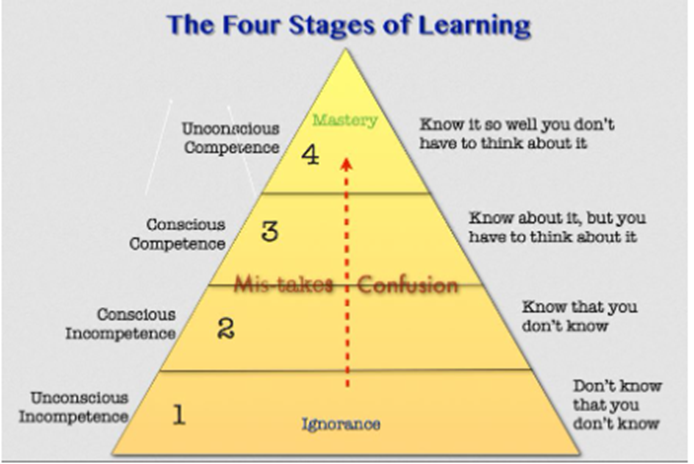
Photo surce: https://www.zen-tools.net/stages-of-learning.html
It is an iterative process that takes a while. It is also easier to do it with outside support to see the achievements in the process and receive feedback. This is where a support group or a life coach can help.
I recently finished “Immunity to Change.” It is a comprehensive model that could help various personality types. There are many models that we coaches apply to empower our clients to make the change they want. The goal in coaching is to select a suitable model for the combination of personality and circumstances to allow the learning process to take place and unlock the client’s potential.
This is how this model works; By filling out the chart below, we can create a picture and a plan for our path to change.

From the book Immunity to Change by Robert Kegan and Lisa Lahey
Column 1- Commitment (improvement goals): Think about the most challenging part of your life and ask yourself, what would be the most critical change in me that can improve my contribution to this challenge? What behavior is limiting you from being yourself in this challenge? If you feel comfortable, ask for feedback from those involved or who know about your life challenge.
Column 2 – Doing/not Doing: These are our behaviors. What am I doing against this goal? If you’d like, make this column private. The more honest you are with yourself, the better results you will gain. But the goal is not to shame yourself. For example, I fall into people-pleaser mode under the fear of conflict. I agree even if I don’t like a situation, then I feel resentment. I listen to learn what people want to do and forget my own wants and needs. I don’t want to upset people by pushing them out of their comfort zone. I compromise my desires and sometimes my needs.
Column 3 – Hidden competing commitments and the worry box: Hidden commitments are part of our psychological immune system to keep us safe. These are our rescuers from old dangers. We needed to adopt these worries as our defense mechanism, especially when we were young. They can be based on old threats.
What we write here can be unexpected for us. We need to stay non-judgmental about what comes out and practice self-acceptance. These are our self-doubts, criticizing inner voice, and worries that have become so natural in our mind that recognizing them may take a while.
The first three columns show us our immunities to change. Take time to fill out the first three columns. Returning to each one and modifying it as you learn more about yourself. After filling out the first 3 columns, we begin to see the contradictions between our improvement goal and the hidden commitments. One sign of having a clear picture from these columns is when we feel uncomfortable by learning about some of our behavior that contradicts our improvement goal.
Column 4 – Big assumption: These are our mindsets and beliefs. Here we learn that reducing or eliminating our behavior, hidden commitments, or mindset abruptly will not work. They are our defense mechanism and have served a purpose in the old days, but they have become a pattern in our subconscious and stayed there with us even when there is no longer any danger. Are those old threats and dangers still relevant? Danger could be feeling ashamed, belittled, bullied, unloved, ostracized, etc.
First SMART Experiment: Designing a relatively safe experiment on our big assumption is essential. This is only research about our assumption and not a self-development step yet. This is only a test. Its result is only for learning purposes. Design it for a safe yet challenging environment to see whether your assumptions are correct. A good test conforms to the S-M-A-R-T criteria where S is for safe, M is for modest, A is for actionable, R is for research stand (the test’s purpose), and T is for the test.
Running the test: After we run the test, we need some reflection. Taking notes on what I did, what happened, whether there was any feedback, did I gather quality data (not based on my own assumption from other people’s heads), and what does the data say about my big assumption?
Designing a New Test & Hooks and Release: Here, the iterative process allows us safely and step by step to move towards a new pattern of beliefs and behavior. We are firing neurons in a safe way to allow them to wire together and become our new neural paths for our new behavior. There is a saying that neurons that fire together wire together.
This blog is a simplified version of the model. It also focuses on an individual’s development. However, practicing this way of learning, especially as an iterative process, can bring a new opening to our lives and allow us to confidently approach growth. The model also offers group development, especially for leadership and organizations. In that version, the authors provide insight into how different personalities can work together with curiosity and non-judgmental behavior.
If you’d like to learn more about adult vertical development and self-growth, please visit my website and blogs at www.shabnamcurtis.net
Schedule a complimentary conversation here to allow me to bring you more light on effective self-growth models.
Everyone is searching for more connections to life. Everyone has a different path. Be you and keep going.
Here is a great video that explains Immunity to Change Model by the author.
Photo by Nataliya Vaitkevich on Pexels.com

 Integral Life Coaching